

Big things start small.
A conversation. A drawing. A student imagining flowers outside a school entrance.
Sometimes, a garden begins long before the first seed touches the soil.
At Ella Baker Global Studies and Humanities Magnet School in Minneapolis, there was a question:
What if a school garden could help heal and strengthen a community?
The answers came from students first.
They imagined birds, bees, vegetables, flowers, ponds, pathways, benches, and outdoor classrooms. They wanted places to grow food, gather with neighbors, and learn outside together.
What they were really imagining was belonging.
That dream became a garden.
But first, it became relationships.
The Ella Baker community garden began with educator and urban farmer Leslie Topness, who saw both the possibilities and challenges facing public education. Budget cuts, food insecurity, and growing inequities weighed on families and schools.
"My daughter told me school lunch wasn't enough food," Topness explained. "So I started wondering how a garden could help feed our community."
She believed a garden could become more than a collection of plants. It could become a place for wellness, curiosity, environmental learning, and community care.
That vision grew through partnerships.
The Strong Mind Strong Body Foundation and its Youth Community Journalism Institute joined the effort, bringing youth leadership, journalism, storytelling, and food justice education to the project. Artist, food historian, and community educator Willa Bartholomay helped deepen the work through arts and community engagement.
Together, students began exploring food systems, environmental stewardship, and the connections between people, place, and community.
When Immigration and Customs Enforcement (ICE) activity affected Minneapolis neighborhoods during the winter, many families experienced fear and uncertainty. Students began asking practical questions: How do communities support one another during difficult times? What does collective care look like?
Food justice stopped being a classroom topic and became a community conversation.
The answers didn't come from a textbook. They came through action.
In spring 2026, students, families, educators, neighbors, artists, and volunteers gathered to bring the vision to life.
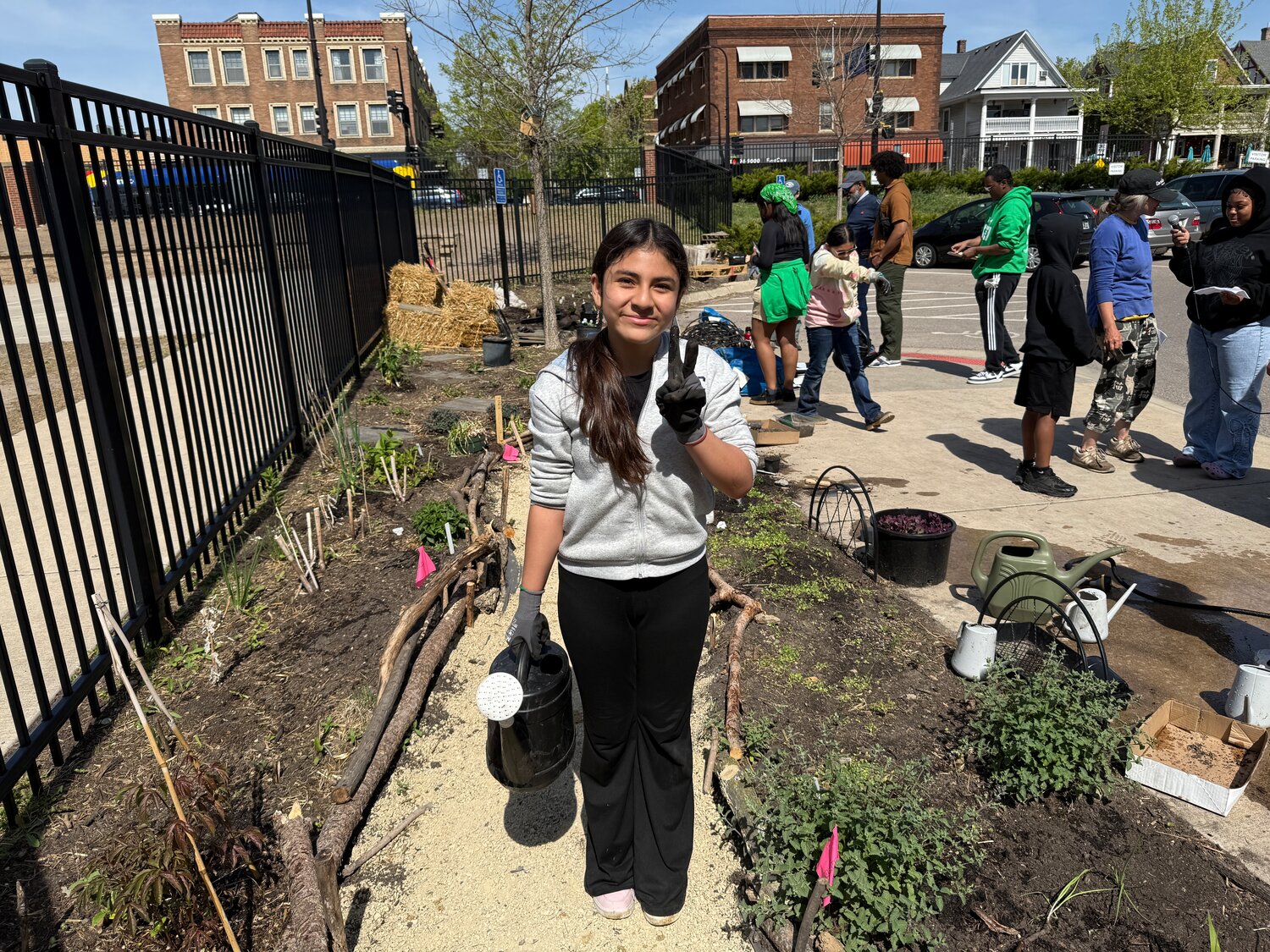
The front entrance circle near the school flagpole transformed into a welcoming community garden. A path was built. Raised beds appeared. Pollinator habitats came alive from recycled materials. Cherry and plum trees were planted. Raspberries and strawberries found homes in the soil after students requested berry patches. Flowers, herbs, and native plants helped create spaces for people and pollinators.
Music played while volunteers worked. Students carried watering cans and wheelbarrows. Families who had never met before shared tools, stories, and food.
The garden became something larger than landscaping. It became a gathering place. Not because it solved every issue facing the community, but because it created something rare: a shared public space where people could build something meaningful together.
That matters a lot today. Public schools are being asked to solve enormous social problems while receiving fewer resources and support. Yet schools remain one of the few places where people from different backgrounds, languages, cultures, and generations come together.
Gardens strengthen those connections. They remind us that communities grow the same way plants do: through patience, care, cooperation, and long-term investment.
This work reflects a larger movement happening across Minneapolis. From East Phillips to North Minneapolis to neighborhood gardens throughout the city, communities are reclaiming relationships with land, food, healing, and collective care.
Alissa Case and Vanessa Hoff, partners in the Community Growers program at Ella Baker and founders of The House of Possibilities, are among those helping advance that vision. Through The People's Garden project in Lowry Hill East, they are working with neighbors to create a community space where anyone can access free food and plant medicine while building relationships across generations.
"Learning how to grow our own food and envision spaces that don't exist yet are crucial skills for people of all ages," they said. "We believe that a garden has the power to become a communal space where people can share food, skills, stories, and wisdom while building a future where everyone can thrive."
That spirit exists at Ella Baker.
Students documented the journey through a 44-page Community Growers magazine, a student-produced song called "Dig a Little Deeper," and a documentary titled "Don't Ever Stop Dreaming."
The garden isn't finished. In many ways, it's just beginning.
Students continue helping shape the vision for what the space can become. An outdoor classroom, pollinator habitat, rainwater catchment system, cultural growing space, wellness area, and year-round community resource.
The project also carries an important lesson about education itself.
Young people are often underestimated. But when students are trusted to ask questions, tell stories, develop solutions, and put those solutions into action, they rise to the challenge.
This is what education looks like when imagination is treated as a community asset instead of a distraction.
A garden begins with a dream. Then people come together to grow it.
Community garden workdays are at Ella Baker School (1200 W. 26th St., Minneapolis) every Saturday from 10 a.m. to 12 p.m. this summer through Sept. 5. Everyone is welcome to join students, families, educators, and neighbors in building and caring for the garden together.
Eric Ortiz lives in the Wedge with his family. He is executive director of the Strong Mind Strong Body Foundation, a national youth and community development nonprofit based in Minneapolis, and associate director of research for The Pivot Fund, a venture philanthropy organization that invests in community newsrooms serving underserved communities.



Comments
No comments on this item Please log in to comment by clicking here