In October, I wrote an op-ed in the Star Tribune saying that Minneapolis “has a problem” with its finances. As a first step toward easing the burden on Minneapolis homeowners, renters and businesses, I called for bringing the proposed 2027 levy increase down from the 11.9% maximum to 6%. That would mean finding about $30 million in savings, roughly 4% of the city’s $753 million General Fund budget.
I still believe that is a good first step. But the more time I spend in my first budget process, the more I see a set of related challenges, and as I said in my op-ed, the first step is admitting what they are:
1 .A 2027 budget challenge. We need to find savings now, so we aren’t adding to costs that residents and businesses are already struggling with.
2. A structural (and growing) gap between what we take in and what we spend. Spending has outpaced our regular revenue for several years. Left alone, we risk running out of savings within a few years.
3. A short-term lens. Most of our debate is about next year, not the next five years, which is where problems can be spotted early, discussed and addressed. “An ounce of prevention is worth a pound of cure” as the saying goes.
4. An information gap. Residents and officials alike struggle to get clear facts on where the money goes, and even on how the city works, because it is large, complicated and at times feels like a black box. This is an issue where the deeper you go into the weeds, the easier it is to start feeling lost. This is especially true for the vast majority of us who are not experts in municipal finance.
The good news is that we are not alone. Many American cities have faced and are facing the same pressures, and there is a lot to learn from how others are handling them.
So I hope you join me on this journey as we learn. The point is not to win an argument. It is to get the facts on the table, so we can talk honestly about what it takes to put the city on solid footing and invest in the services that make Minneapolis thrive.
This week covers the basics: the city’s different budgets, where the money comes from and goes, and who decides what, and when. Over the next few weeks, we’ll cover what it all means for your tax bill, how we got here, where 2026 is landing and what the 2027 budget does, the longer-term outlook, and what I’ve learned along the way.
Please send me your questions as we go.
One $2.3 billion budget is really six smaller ones
Minneapolis’s 2027 budget totals $2.29 billion. In practice it’s six smaller budgets, each with its own money and its own rules.
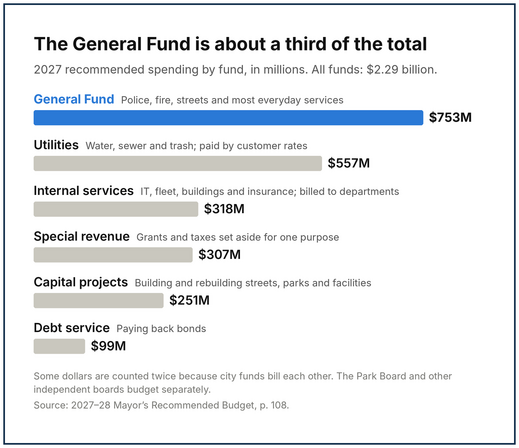
Most of our focus will be on the General Fund: $753 million that pays for police, fire, streets and most everyday services. Property tax covers about half of it, and it is where the Mayor and Council have real choices. But the other budgets aren’t walled off, and that’s where a lot of the complexity starts:
• Utilities ($557 million), including water, sewer, trash and city-owned parking, run on fees you pay, not property tax. But those bills are still rising: the average household’s utility bill is going up 5% to 6% a year.
• Internal services ($318 million), like technology, the vehicle fleet and self-insurance, are billed to departments across the city. The General Fund pays a large share of those bills, and what it pays is growing faster than the rest of its spending.
• Special revenue ($307 million) is money with strings attached, including downtown sales and hospitality taxes. In recent years, money from the downtown tax fund has increasingly been used to help fill gaps in the General Fund.
• Capital projects ($251 million) and debt service ($99 million) build streets, bridges, buildings and parks, mostly with borrowed money, much of it repaid through property taxes. Our overall debt remains healthy, but planned borrowing is rising and will add to future property tax needs.
We’ll come back to internal services, special revenue, and capital and debt in future issues. Trends in each of them will shape what the General Fund can do to support the city’s needs.
The General Fund: where money comes from, and where it goes
Here is last year’s General Fund, using the city’s audited 2025 numbers.
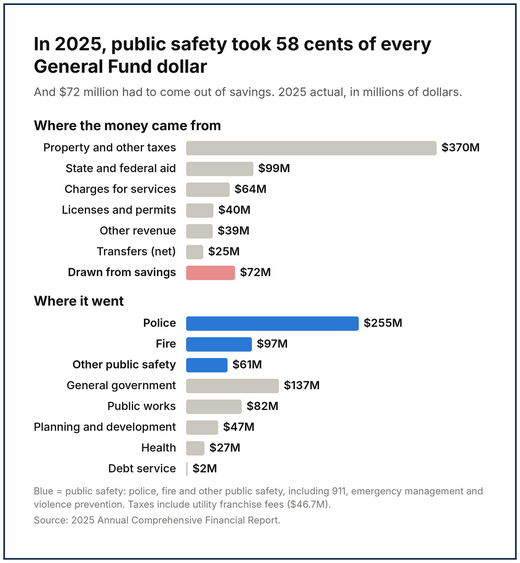
Coming in: taxes, mostly property tax, pay for about half. Minnesota doesn’t let cities tax income, so our next biggest source is the state’s Local Government Aid.
Going out: police, fire, 911, and neighborhood safety initiatives take 58 cents of every dollar. That share is in line with history: public safety has taken 57 to 59 cents of every General Fund dollar in most years since 2014.
One critical note: the city’s Local Government Aid from the state is about the same number of dollars it was 20 years ago, $82.5 million in 2004 and $81.6 million in 2025, while prices have risen roughly 70%. As that aid has stood still, more of the load has shifted onto local property taxpayers. Had it kept up with inflation, the city would be receiving almost $60 million more each year.
The emerging problem
For years, the money coming in and the money going out stayed close together. Since 2022 they have come apart.
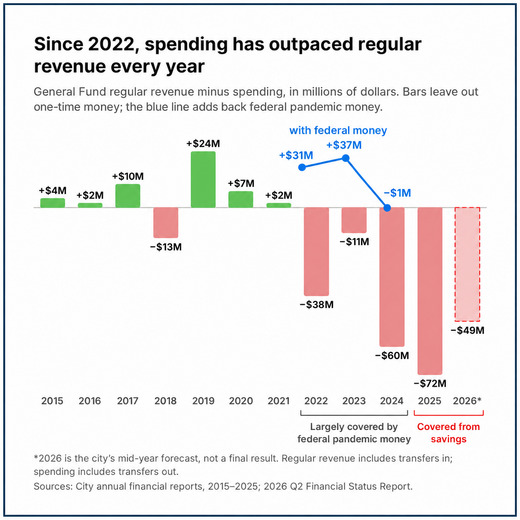
Federal pandemic money largely covered the gap from 2022 to 2024. In 2025 that money was gone, and the city covered a $72 million gap from savings. The city’s mid-year forecast has another $49 million drawn from savings in 2026
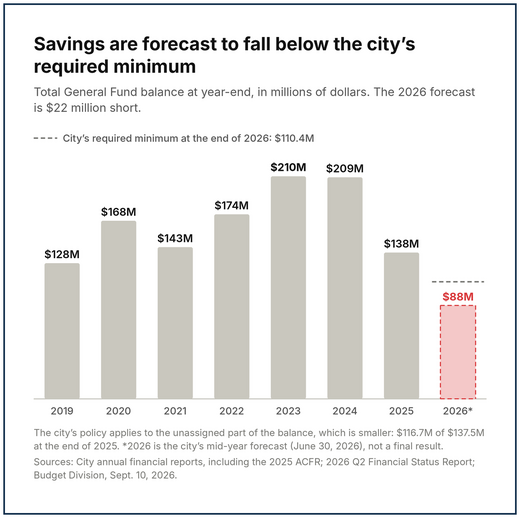
The General Fund ended 2024 with $209 million in savings and 2025 with $138 million. The city’s own mid-year forecast has 2026 ending at about $88 million, $22 million below the minimum its policy requires. Savings are meant to be a cushion for a bad year, not a regular source of income. That is the thread we’ll keep pulling on in the weeks ahead.
The budget timeline
1. August 12: the Mayor proposes a $753 million General Fund and an 11.3% levy increase.
2. August to October: the Council reviews. The Budget Committee heard about 40 presentations from city departments.
3. September 29: the ceiling is set. The Board of Estimate and Taxation capped the levy increase at 11.9%, set above the Mayor’s 11.3% to accommodate the Park Board’s full request. From here, the levy can go down but not up.
4. November: notices arrive. Hennepin County mails each property owner a Truth in Taxation notice showing their estimated 2027 tax at the maximum.
5. Early December: the Council amends. Council members propose and vote on changes to the Mayor’s budget, starting December 10.
6. December 15: the final vote. After the Truth in Taxation public hearing that day, the Council votes on the budget and the levy. It takes seven votes and the Mayor’s signature.
Where we are now: notices are reaching mailboxes and the Council’s amendments are about a month away. This is the window where public input matters most.
Key takeaways from this week
• The city has more than $2 billion in budgets, but most of it is restricted. The key debate is about the $753 million General Fund, but understanding the city’s financial health means looking beyond it.
• Property tax pays for about half of the General Fund, and public safety takes 58 cents of every dollar it spends.
• Local Government Aid from the state is about what it was 20 years ago, so local taxpayers are carrying more and more of the load.
• Since 2022, spending has run ahead of regular revenue. Savings are now covering the gap, and reserves are forecast to fall below the city’s minimum before the end of the year.
Where we’ll go next
Next week we’ll bring this to life: what it means for your property tax bill and your utility bills, and why homeowners, renters and businesses are seeing very different changes. Read more by signing up for the Ward 7 e-newsletters.
Questions? Write to me at ward7@minneapolismn.gov.
Sources
City of Minneapolis 2027–28 Mayor’s Recommended Budget; City annual financial reports, 2015–2025; 2026 second-quarter financial status report; Budget Division, 2027 Budget Overview presentation to the Budget Committee, September 10, 2026; Minnesota Department of Revenue Local Government Aid certifications; City of Minneapolis 2027 budget calendar. The 70% price increase since 2004 is an estimate based on the consumer price index.
Elizabeth Shaffer shared this information in her Ward 7 e-newsletter.



Comments
No comments on this item Please log in to comment by clicking here